Mental wellness care has undergone tremendous change within the past few years and Maryland citizens can see how the trend is manifesting itself. Many patients who once relied solely on primary care doctors Maryland communities trust are now turning to virtual psychiatry for faster, more convenient support. This growing comfort with telehealth reflects a broader change in how people access behavioral health services across the state, blending traditional care with digital convenience.
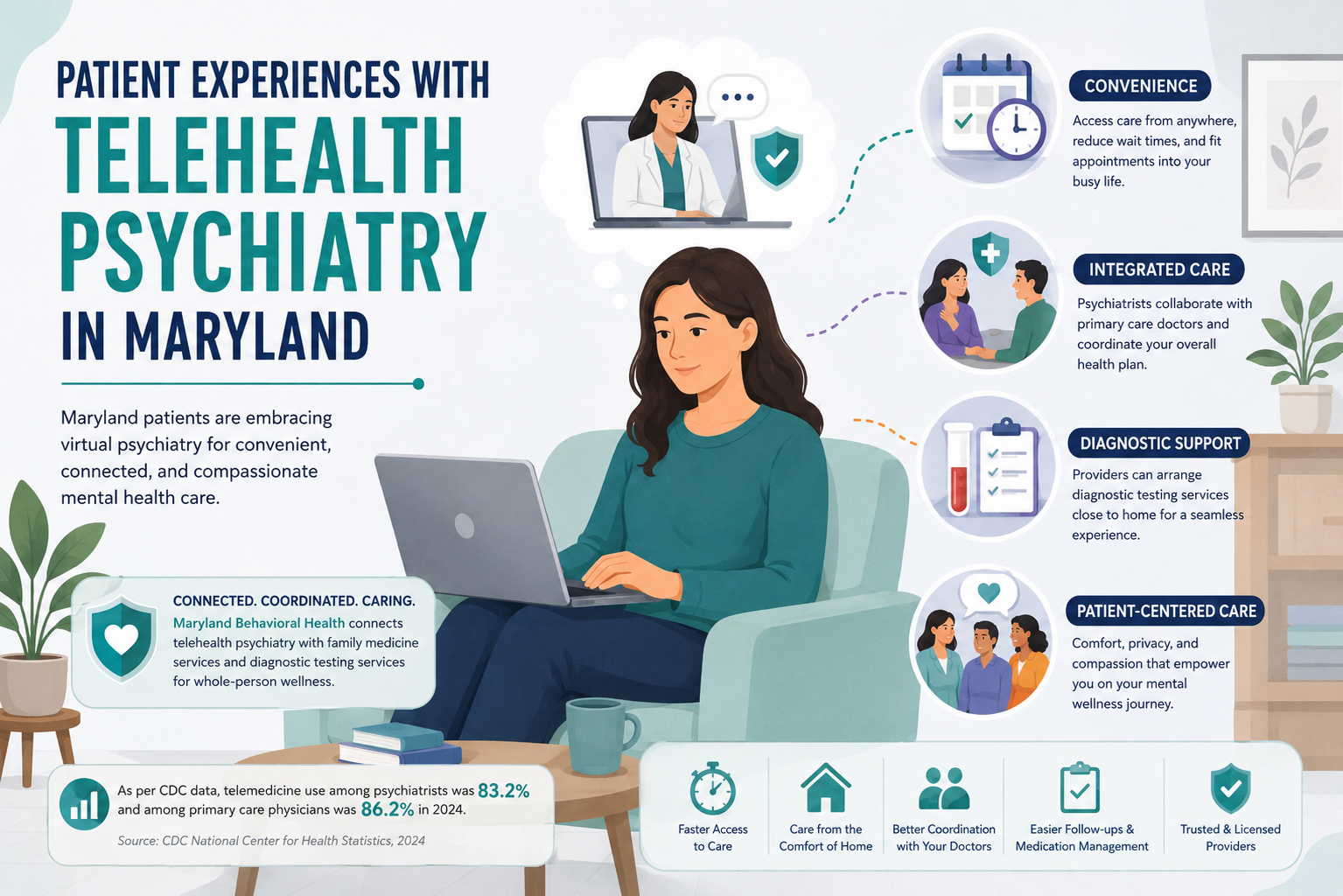
The numbers back this up. As per the CDC’s National Center for Health Statistics report, the use of telemedicine among office-based physicians specializing in medicine, e.g. psychiatrists, was at 83.2% in 2024, while primary physicians revealed their telemedicine use was at 86.2% the same year. These statistics make it evident that the two medical fields psychiatry and primary care visits are the top two among the different types of medical care that are very well adapted to telehealth, and Maryland is not an exception.
Why Patients Are Choosing Telehealth Psychiatry
Patients across Maryland describe telehealth psychiatry as a relief from long wait times and limited appointment availability. Instead of driving across town or taking time off work, they can connect with a licensed provider from home. This is especially valuable for people who already juggle visits to primary care doctors Maryland offices for routine checkups, since adding another in-person appointment can feel overwhelming.
Platforms such as Maryland Behavioral Health have eased the switch to virtual care by providing patients with both psychiatric support and comprehensive well-being programs in a coordinated way. A large number of patients state that the availability of a network of trusted providers that works much the same way as the local physicians Maryland patients go for their physical needs, makes them quite confident of their treatment program.
The Role of Integrated Care
One theme that comes up repeatedly in patient feedback is the value of integration. People don’t want their mental health care siloed away from the rest of their medical history. Patients get the impression that their treatment is much more comprehensive when a psychiatrist who provides telehealth services works in parallel with family medicine services. Besides a patient’s mental condition, psychiatrists can better understand the whole physical situation like any chronic problem and medications prescribed by family doctors, which helps them make more accurate psychiatric decisions.
This is where diagnostic testing services come into play. Since some patients need lab tests or screening before getting their prescriptions, telehealth psychiatrists in Maryland are coordinating closely to local labs to make the procedure smooth and efficient. Rather than requiring an extra trip, many platforms now schedule diagnostic testing services near the patient’s home and deliver results directly into their virtual care plan. This kind of coordination has made patients feel far more supported than they expected from a purely digital experience.
Real Patient Experiences
Patient reviews across Maryland tend to highlight a few consistent points:
- Reduced anxiety about first appointments: Many individuals find a great degree of comfort in discussing sensitive and difficult aspects of mental health through online sessions in the privacy and intimacy of home, rather than a clinical waiting room.
- Faster access to care: Instead of waiting weeks, some patients report being matched with a psychiatric provider within days.
- Better continuity with existing care: Patients who have a primary care doctor in Maryland and continue to see that doctor feel quite relieved when a psychiatrist through a telehealth platform is directly communicating with the doctor that already treats them.
- Convenience for follow-ups: Medication management check-ins are often quicker and easier over video, cutting down on missed appointments.
Of course, not every experience is perfect. Many patients complain that their connection isn’t the best or that they don’t get a real feeling through a video of a first time session with a person being physically present. Still, a large majority of Maryland residents report positively about a trend that continues to get increasingly refined by the health professionals who now prefer virtual intake and follow-up services.
How Maryland Behavioral Health Supports This Shift
Maryland Behavioral Health has positioned itself as a resource for patients seeking a more connected approach to mental wellness. By combining psychiatric telehealth with access to family medicine services and diagnostic testing services, the platform aims to close gaps that often frustrate patients navigating multiple providers. This model reflects a growing expectation among Maryland residents: care shouldn’t feel fragmented, even when delivered virtually.
Many patients working with Maryland Behavioral Health say that the psychiatric support they get can be a very big thing not running completely independent from their state of overall health. For many, this integrated approach mirrors the kind of continuity they’ve come to expect from primary care doctors Maryland communities have relied on for decades, just delivered through a modern, virtual-first model.
Key Takeaways
- As per CDC data, telemedicine remains widely used among both medical specialists and primary care physicians, reflecting strong national momentum behind virtual psychiatric care.
- Integration with family medicine services and diagnostic testing services improves patient satisfaction and treatment accuracy.
- Convenience, reduced wait times, and comfort discussing sensitive topics from home are top reasons patients prefer virtual psychiatry.
- The coordination among a patient’s telehealth provider and their primary care doctor results in more seamless, high-quality healthcare.
- Such organizations as Maryland Behavioral Health support the growth of virtual psychiatry and are slowly bringing about its integration with physical healthcare.
Conclusion
Telehealth psychiatry has become a meaningful part of how Maryland residents manage their mental health, offering flexibility without sacrificing quality of care. As more patients seek treatment that feels connected rather than fragmented, providers who coordinate closely with primary care doctors Maryland families already trust will continue to stand out. With platforms such as Maryland Behavioral Health leading this integrated approach, the future of psychiatric care in Maryland looks more accessible, more coordinated, and more patient-centered than ever.
Frequently Asked Questions
- Is telehealth psychiatry as effective as in-person visits?
Studies have revealed that patients’ overall satisfaction from telehealth psychiatry and face-to-face visits have been mostly similar except in certain cases when a patient has a need to be physically examined during the first visit that can only be done if the patient is with a doctor face-to-face.
- Do I need a referral from primary care doctors Maryland providers to start telehealth psychiatry?
No one should count on always needing such a paper route! Many of the telehealth services allow one to self-refer or walk-through the scheduling system to get appointments without any need for a referral at all. However, having your primary care doctor to be aware of your mental health plan might give a more seamless medical care experience.
- Can telehealth psychiatry providers order diagnostic testing services?
A lot can be achieved even by remote. Some of the psychiatric providers coordinate the lab work or screenings with local labs so that either you don’t have to go or maybe only a couple of times after the diagnosis.
- How does telehealth psychiatry work with family medicine services?
It can really make a difference when your psychiatrist informs the provider who is taking care of your regular physical check-ups so that your mental and physical illnesses get treated together and not separately.
- Is telehealth psychiatry covered by insurance in Maryland?
Largely, insurance companies for health plans are offering similar payment rates for telehealth services as they are for physical visits except for some fine line differences between the insurance plans themselves or from one provider to another.