Ask anyone with ADHD about procrastination, and you’ll rarely hear “I’m just lazy.” What you’ll hear instead is something closer to: I know exactly what needs to get done, I just can’t seem to start. That gap between knowing and doing isn’t a willpower problem. It’s a brain-wiring one. For a lot of adults, this pattern gets tangled up with mood swings, low motivation, and anxiety, and that’s exactly why mood disorder management ends up mattering just as much as ADHD treatment when someone is trying to break out of a procrastination rut.
The numbers back this up. As per the Wifi Talents report found that people with ADHD procrastinate about three times more often than neurotypical peers, largely because executive function deficits get in the way of planning and follow-through. That’s not a minor gap. It says a lot about how differently ADHD brains relate to time, tasks, and self-motivation.
Why ADHD Makes Procrastination So Persistent
ADHD affects executive function the mental toolkit behind planning, prioritizing, and just getting started. When that system isn’t firing the way it should, even a five-minute task can feel like climbing a hill. Throw emotional dysregulation into the mix, which shows up often with ADHD, and suddenly procrastination looks less like a character flaw and more like a coping strategy someone leaned on without meaning to.
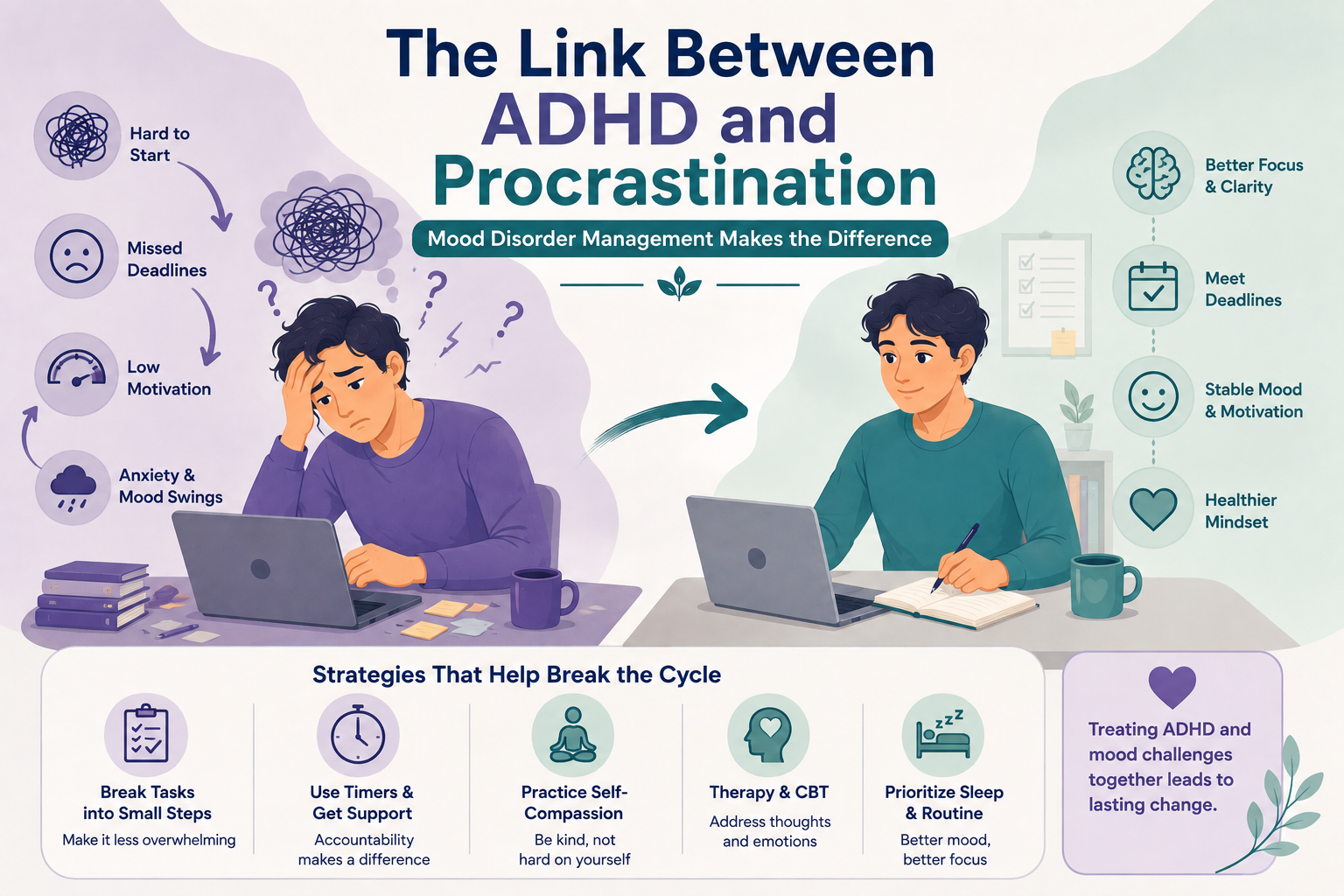
There’s also the mood piece. Anxiety and depression show up alongside ADHD more often than people expect, and when neither gets addressed, avoidance tends to get worse, not better. It’s easy to see how the cycle forms: a missed deadline triggers guilt, guilt lowers motivation, and lower motivation makes the next task even harder to start. Clinicians increasingly pair ADHD-focused strategies with broader mood disorder management so the emotional side doesn’t get left out of the equation. In plenty of cases, real treatment for mood disorders is the piece that finally lets ADHD strategies stick.
The Emotional Side of Procrastination
Procrastination isn’t only a time-management issue, even though it gets treated that way constantly. Underneath it, you’ll usually find fear of failure, perfectionism, or a kind of emotional overload. If your mood shifts without much warning, starting a task can feel less like a logistical step and more like an emotional gamble. Some days a task feels totally manageable, and the next day the exact same task feels impossible, which can be confusing for the person experiencing it and for the people around them.
That’s part of why treatment for mood disorders so often overlaps with what helps ADHD-related avoidance — things like cognitive behavioral therapy (CBT), consistent routines, and, where it makes sense, medication. Providers like Maryland Behavioral Health see this combination constantly, ADHD and mood symptoms showing up in the same person, which is exactly why an integrated plan tends to outperform treating each issue in isolation.
Building Sustainable Habits
Breaking an ADHD-procrastination cycle takes more than good intentions on a Monday morning. Most people already know the general advice — plan ahead, stay organized — but that advice rarely accounts for how an ADHD brain actually works day to day. A few things tend to help more reliably:
- Breaking big tasks into smaller, less intimidating steps
- Using timers or body-doubling for a bit of outside accountability
- Practicing self-compassion instead of beating yourself up after a missed deadline
- Paying attention to sleep and routine, since both quietly shape focus and mood
Working with a therapist trained in mood disorder counseling can help someone untangle the emotional triggers behind chronic avoidance, while a psychiatric provider looks at whether medication needs adjusting. Put together, that’s what mood disorder management looks like in practice: treating the mind as one connected system instead of a set of unrelated symptoms.
When to Seek Professional Support
If procrastination is starting to cost you at work, in relationships, or in how you feel about yourself, that’s worth paying attention to. A licensed provider can figure out whether ADHD, a mood disorder, or both are behind the pattern, and can point you toward mood disorder counseling built around your situation. Staying consistent with mood disorder management alongside ADHD care usually makes the biggest difference over time. Left alone, chronic procrastination has a way of deepening shame and making anxiety or depression worse.
Maryland Behavioral Health offers psychiatric evaluations, therapy, and medication management for adults and teens dealing with ADHD alongside mood-related struggles. Their focus is on integrating the treatment since usually focus problems and emotional ones do not run in separate roads. Booking a consultation with Maryland Behavioral Health is often the simplest way to get a clear, personalized plan instead of guessing at what to try next.
Key Takeaways
- ADHD and procrastination are connected through executive function struggles, not laziness or a lack of discipline.
- People with ADHD procrastinate roughly three times more than neurotypical peers, based on 2026 data.
- Mood disorders like anxiety and depression often make procrastination worse, which is why combined care matters.
- CBT, structured routines, and professional mood disorder counseling can meaningfully cut down on avoidance.
- Treatment for mood disorders paired with ADHD care tends to produce better long-term results than treating either one alone.
Conclusion
Chronic procrastination linked to ADHD can absolutely improve, especially once emotional health is treated as part of the picture, not something separate. The two conditions tend to feed off each other, turning small delays into ongoing stress and self-doubt. Real mood disorder management, paired with ADHD-specific tools like structured routines and CBT, can interrupt that cycle and rebuild steady momentum. Instead of treating procrastination as a personal failing, it’s more useful to treat it as a signal worth exploring with the right support and plan.
Frequently Asked Questions
- Is procrastination always a sign of ADHD?
No way. Everyone from time to time may procrastinate but the chronic and painful avoidance along with poor attention or hyperactivity that result from this combination can indicate the presence of ADHD.
- Can mood disorders cause procrastination without ADHD being involved?
Of course. Depression and anxiety symptoms themselves can significantly reduce motivation and lead to increased avoidance behaviors, regardless of whether they accompany a diagnosis of ADHD.
- What kind of therapy works best for ADHD-related procrastination?
CBT is the most common one, however, it’s frequently accompanied or integrated with various behavioral therapy techniques as well as medication depending on the case, which is very much a matter of judgment.
- How does Maryland Behavioral Health handle these overlapping conditions?
They offer comprehensive mental health services combining both medication and therapy. In treating the symptoms of ADHD and mood-related difficulties, Maryland Behavioral Health sees both as interrelated and therefore treatable as one problem instead of two!
- When is it time to get professional help for procrastination?
Getting a helping hand would be justified, if the procrastination habit is adversely affecting your work, relationships, or feelings about yourself.