Ask an adult with ADHD how they’re doing by 3 p.m., and “wiped out” comes up a lot. Not sleepy, exactly more like they’ve been running a background app all day that never quits. That kind of tiredness isn’t about being lazy or undisciplined. It’s what happens when a brain has to work harder just to get through an ordinary Tuesday. Recognizing that pattern matters, because it points toward better chronic care management rather than another round of self-blame ADHD rarely gets better through willpower alone.
The scale of this is bigger than most people realize. As of 2026, about 6.0% of U.S. adults roughly 15.5 million people currently live with a diagnosed form of ADHD, according to a National Center for Health Statistics survey. That figure keeps climbing as more adults get identified later in life, and it’s a big part of why long-term support, not quick fixes, actually moves the needle.
The Hidden Cognitive Load Behind ADHD Fatigue
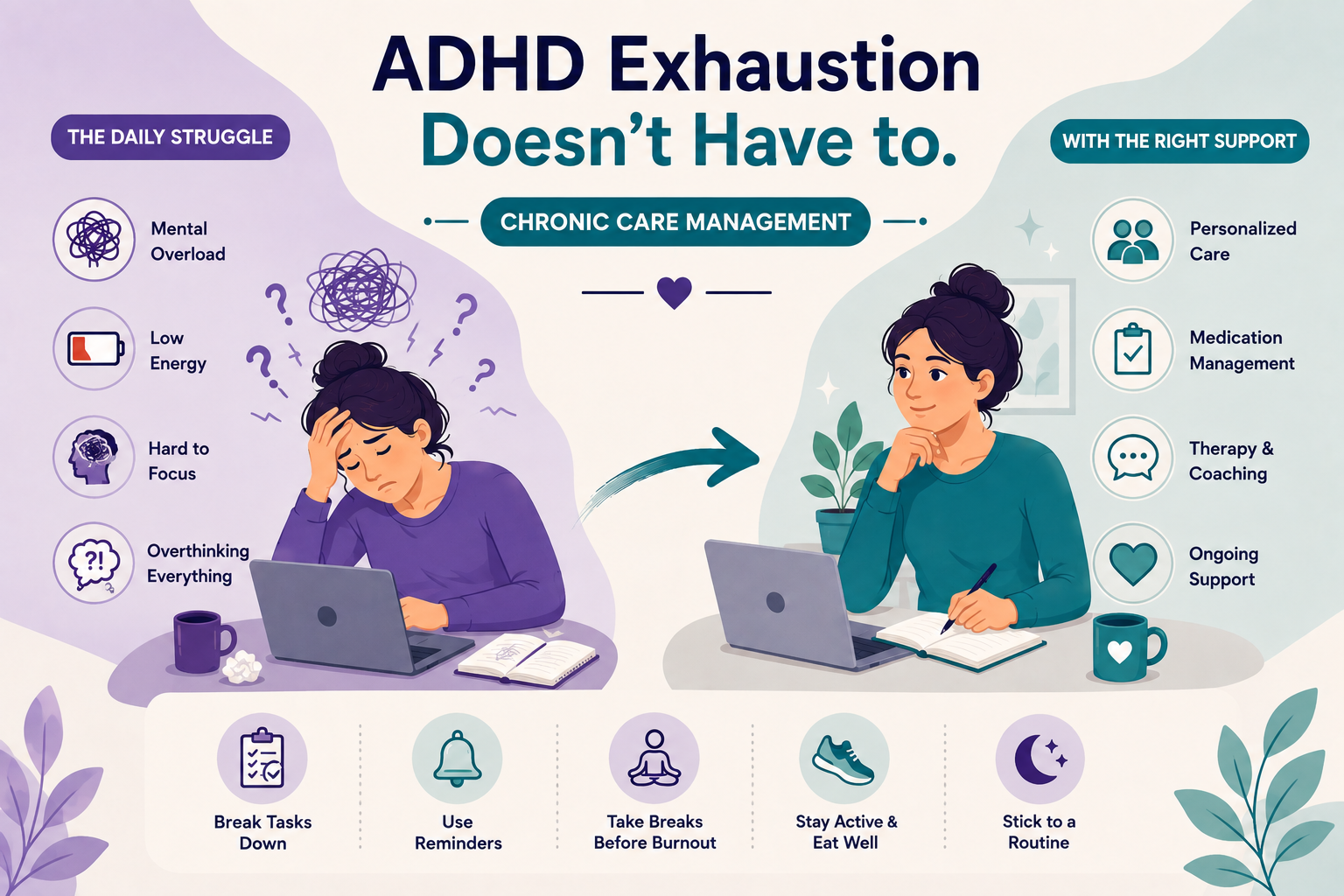
Here’s the thing most people miss: tasks that look effortless from the outside often aren’t. Replying to a routine email, remembering a dentist appointment, tuning out a coworker’s chatty phone call each one asks more of an ADHD brain than a neurotypical one. Since they have different levels of Executive Function, the ADHD brain constantly fills in gaps in planning, working memory, and impulse control. In fact, it’s as though the extra background processes no one can see get run simultaneously. Add that up across a full day, and it’s no surprise many adults hit a wall well before lunch.
Why “Just Resting” Doesn’t Fix ADHD Exhaustion
A good night’s sleep helps, sure. But it doesn’t touch the root cause. ADHD is a chronic neurological condition, and much like other chronic disease management challenges, it responds better to steady, ongoing strategies than to the occasional day off. Skip the structure, and adults tend to swing between burnout and short productive sprints a cycle that leaves people more exhausted than when they started.
The Everyday Cost of Going Without a Plan
What does this look like day to day? Missed deadlines that trigger a fresh wave of guilt. Forgotten refills that turn into a rocky week. A conversation where someone’s mind wanders mid-sentence, followed by the quiet embarrassment of asking “sorry, what were you saying?” None of this is a moral failing it’s what happens without the right support. And since ADHD often overlaps with anxiety, depression, or sleep issues, the fatigue rarely stays contained to one part of life; it spills into work, relationships, and health all at once.
Building a Coordinated Plan for Long-Term Support
This is where chronic care management really pays off. Adopting a holistic approach to ADHD care – medication review, therapy, lifestyle coaching, and periodic check-ins – instead of labeling ADHD and then leaving the person to their own devices, adults can be taught how to maintain routines that will last even under stressful real-life situations. At Maryland Behavioral Health, clinicians work directly with adults to shape individualized plans that lighten the mental load ADHD creates, rather than piling more onto an already full plate.
How Ongoing Care Coordination Reduces Burnout
Having someone track the moving pieces makes a real difference. Care management services bring order to what can otherwise feel like a nonstop juggling act — a dedicated coordinator can keep tabs on medications, follow up on therapy progress, and loop in extra resources the moment a new stressor shows up. That kind of oversight matters even more for adults juggling ADHD alongside other chronic disease management needs, whether that’s anxiety, depression, or a physical health condition that tends to travel alongside it.
Practical Strategies That Actually Stick
Clinical support matters, but the small stuff adds up too: breaking big tasks into smaller ones, swapping memory for visual reminders, and building in rest before exhaustion hits rather than after. Folded into a broader chronic care management plan, these habits stop being one-off hacks and start becoming part of how someone lives. Maryland Behavioral Health weaves these tools directly into treatment plans, so adults aren’t stuck guessing what to do between appointments.
Why Ongoing Support Beats One-Time Fixes
ADHD doesn’t take a break just because someone had a good week. That’s why care management services work best as a relationship over time, not a single visit checked off a list. Regular check-ins let medication, therapy, and coping strategies shift as life shifts a new job, a new relationship, added family responsibilities can all change how symptoms show up. Effective chronic care management, in the end, means the plan bends around the person, not the other way around.
Key Takeaways
- ADHD-related exhaustion comes from constant, mostly invisible mental effort — not a lack of motivation.
- Rest helps, but it won’t resolve ADHD fatigue on its own; that takes structured, ongoing support.
- A coordinated treatment plan pulls medication, therapy, and coaching into one approach instead of scattered fixes.
- Care management services give adults with ADHD the consistency they need to break repeated burnout cycles.
- Coordinated, individualized support helps adults manage ADHD alongside other chronic conditions over the long haul.
The Bottom Line
Mental exhaustion in adults with ADHD isn’t a character flaw — it’s a predictable result of how their brains handle daily demands, often long before any task actually gets finished. Fixing it takes more than willpower or a few decent nights of sleep. It takes real chronic care management: consistent medication review, therapy, and daily strategies that flex as life changes. Once that kind of structured, ongoing support is in place, ADHD tends to stop feeling like a constant uphill climb and starts feeling manageable, one day at a time.
Frequently Asked Questions
- Why do adults with ADHD feel tired even after a full night’s sleep?
Because ADHD fatigue is not the kind that comes from exertion, it rather results from managing attention, memory and feelings, and sleeping is no way you’re going to address that.
- Is ADHD considered a chronic condition?
Yes. It’s lifelong, which is exactly why ongoing chronic disease management, rather than a one-time treatment, tends to work best.
- How does a coordinated treatment plan help with ADHD?
Coordinating treatment plans help to treat ADHD because one can integrate medication, therapy, and lifestyle changes together instead of adults trying to make a care plan all by themselves.
- What does ongoing ADHD care coordination actually include?
A team member or a coordinator who monitors medications, evaluates therapy progress, and links patients with resources as the patient’s needs change.
- Where can adults get support for ADHD-related exhaustion?
Clinics such as Maryland Behavioral Health build structured, individualized plans around each adult’s actual symptoms and routine.