If you think your brain just never turns off, you’re not just imagining it. The barrage of notifications, the constant decisions to make, the emotional tension, sleep deprivation, and stress altogether can keep the nervous system in an overloaded state. As per the American Psychiatric Association research, 48% of adults said they felt more anxious than the previous year, highlighting how sustained mental strain has become part of daily life for many people. Persistent overstimulation could be a reason for some people to seek help professionally by contacting psychiatric services maryland and benefit from tailored care plans that will take into account both emotional and biological factors.
For additional help and information, check out the maryland behavioral health site.
Key Takeaways
- There’s a good chance that mental overstimulation is caused by prolonged stress, the continuous intake of information, and emotional exhaustion.
- When your mind is overloaded, it might signal you by overthinking, feeling very upset, losing focus, and getting very tired.
- Changing your lifestyle is a way to deal with it but long-standing problems might call for a health care professional.
- When symptoms are severely affecting one’s functioning, combining mental health medication and therapy may be a very effective solution.
- Getting assistance early can lead to better concentration, emotional control, and a more satisfying life.
What Does an Overstimulated Brain Feel Like?
Mental overstimulation is not simply “being busy.” It happens when your brain processes more emotional, cognitive, and sensory input than it can comfortably manage.
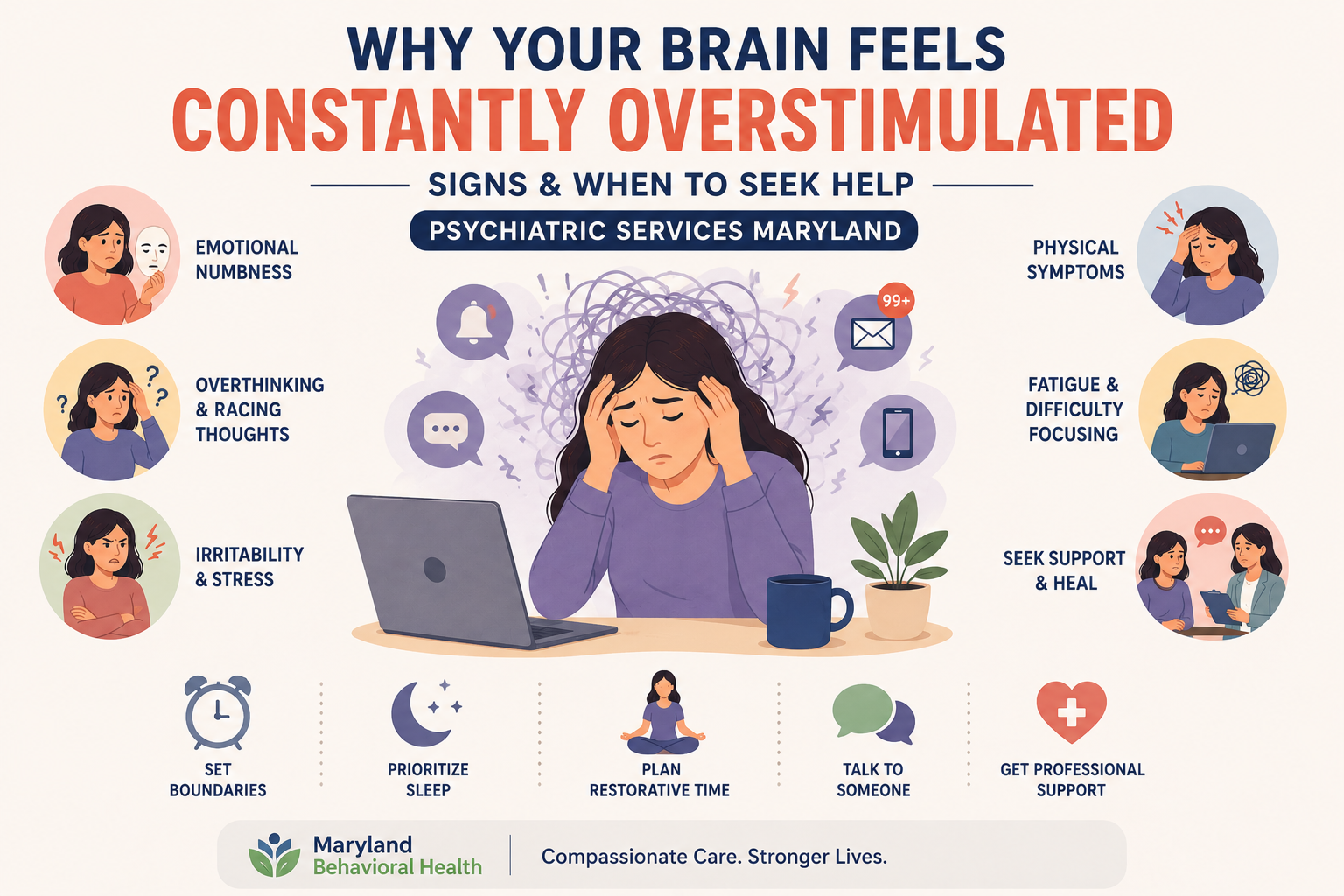
People often describe it as:
- Feeling mentally exhausted but unable to relax
- Racing thoughts at night
- Becoming irritated by small disruptions
- Difficulty focusing on one task
- Emotional numbness or sudden emotional reactions
- Physical tension, headaches, or restlessness
Although your brain is made to alternate between being alert and recovering, if there are no “recovery” moments, the nervous system can be active longer than the brain intended.
Common Reasons Your Brain Feels Constantly Overloaded
1. Endless Digital Input
Nowadays, it’s pretty hard to find moments of silence. Email inboxes, social media, texts, news notifications, and entertainment all fight for your attention every day. Our brain’s attention system is not designed for such continuous exposure to stimulation. Frequently shifting focus from one task to another drains our minds and at the same time, makes it hard to rest our brains.
2. Emotional Burnout
Emotional burnout does not only happen at work. Caregiving responsibilities, relationship strain, financial stress, and internal pressure to “keep up” can create chronic mental activation. Over time, your brain begins treating everyday demands like ongoing emergencies.
3. Chronic Anxiety and Stress Responses
If stress is going on for a long time, the body might keep creating stress reactions even though there is no actual threat around. That’s why some people become so sensitive, overthink, and get stuck to the point of not being able to relax anymore. Usually, people think that it is their lack of discipline or motivation that is causing the problem when actually, it is their nervous system being overloaded.
4. Sleep Disruption
During sleep, the brain not only sorts out the information but also replenishes its mental energy. Next day, the most simple stimulation may seem to be a source of stress, if one has not slept well. Repeated sleep disruption often creates a cycle of fatigue and overstimulation.
When Overstimulation Becomes More Than Stress
Occasional overload is common. Nevertheless, if after a few weeks the signs are going on and in fact start to cause you problems at work, with your family, your sleep, or your day-to-day activities, going in for a check-up might be the right thing to do.
Among symptoms you should be on the lookout for are:
- Ongoing stress
- Feeling emotionally dead
- Getting panic attacks
- Having a hard time focusing
- Major mood swings
- Not enjoying things anymore
This is where structured care can make a meaningful difference. Psychiatric Services Maryland may include assessment, therapy recommendations, and coordinated treatment approaches designed around individual needs. Plans for patients at Maryland Behavioral Health might feature a combination of therapy plus scientifically validated methods targeted at achieving emotional stability and enhanced functioning over time.
How Treatment Can Help Calm an Overstimulated Brain
Quite often, recovery does not mean doing away with all stress. In fact, it is more about enabling the brain to become more flexible and capable of recovery again.
Helpful approaches may include:
- Counseling and Therapy
Professional counseling services can make a great difference by helping to recognize triggers, develop new coping mechanisms, and establish healthier emotional boundaries. Besides, therapy can also decrease the constant inner dialogue that makes people feel “always on.”
- Medication Support When Appropriate
For some individuals, symptoms are influenced by underlying anxiety or mood-related concerns. Thoughtful mental health medication management helps ensure medications are monitored, adjusted appropriately, and aligned with broader treatment goals.
- Addressing Mood Patterns
Individuals who experience prolonged overstimulation may also be affected by depression, anxiety, or emotional dysregulation. Professional treatment for mood disorders can alleviate the symptoms and, at the same time, help people to strengthen their emotional resilience. Maryland Behavioral Health emphasizes individualized care because what overloads one person may affect another differently.
Small Daily Habits That Can Reduce Mental Overload
You do not need a complete lifestyle reset to start creating relief.
Try:
- Scheduling short periods without screens
- Limiting multitasking
- Creating transition time between work and personal life
- Prioritizing consistent sleep routines
- Practicing moments of intentional quiet
- Moving your body regularly
But on the other hand, minor, frequent changes may result in greater effectiveness than a major overhaul being done once in a while.
In case of symptoms of sleep teeing up even after lifestyle changes, Psychiatric services maryland may be worth considering for further guidance and assistance.
Conclusion
A constantly overstimulated brain is often a signal that your mental and emotional systems have been carrying too much for too long. While stress is unavoidable, living in a constant state of overload does not have to become normal. Whether support includes counseling services, mental health medication management, or targeted treatment for mood disorders, getting help early can make daily life feel more manageable. Maryland Behavioral Health offers resources designed to help people move from constant mental noise toward greater balance and clarity.
FAQs
Q1. Why does my brain seem very busy even when I am relaxing?
Ans: Even if your body is resting, your brain may still be dealing with the stress, emotions, or overstimulation that you experienced during the day. Restoring the body and mind to their best state normally requires both time for relaxation and a good quality sleep.
Q2. Can anxiety cause a sensation of being mentally overstimulated?
Ans: Indeed. Anxiety keeps the nervous system in an activated state resulting in rapid, repetitive thoughts which is difficult to control or shut off.
Q3. Can counseling services help in cases of overstimulation?
Ans: Definitely. Counseling services assist in helping one to recognize the stress triggers, enhance coping mechanisms, and lessen emotional load.
Q4. What are the signs that someone should consider treatment for mood disorders?
Ans: A person may want to consider a professional treatment for mood disorders if a low mood, being emotionally drained, or anxiety continues over a period and interfere with one’s daily life.
Q5. Is therapy obsolete when one manages their medication for mental health?
Ans: Not necessarily so. Mental health medication management is usually most beneficial when it is used together with talk therapy and positive changes in lifestyle.