Choosing a mental health treatment path can feel overwhelming, especially when terms like “CBT” and “talk therapy” get used interchangeably. These two things are actually different, and figuring this out makes it easier for you to, or your loved ones, to decide on the one that’s better for you quickly. Many people also wonder whether therapy alone is enough or whether Medication Management Services should be part of the plan.
The need for clarity here is real. As per the Statista report, around 57.3 million U.S. adults received treatment or counseling for a mental health condition within the past year, published in August 2026 using SAMHSA survey data. That number also refers to people who only used medications to treat their problems, besides those who got the talk-based treatment. That alone proves how frequent it is for efficient care to mean using several methods rather than only relying on one.
What Is Talk Therapy?
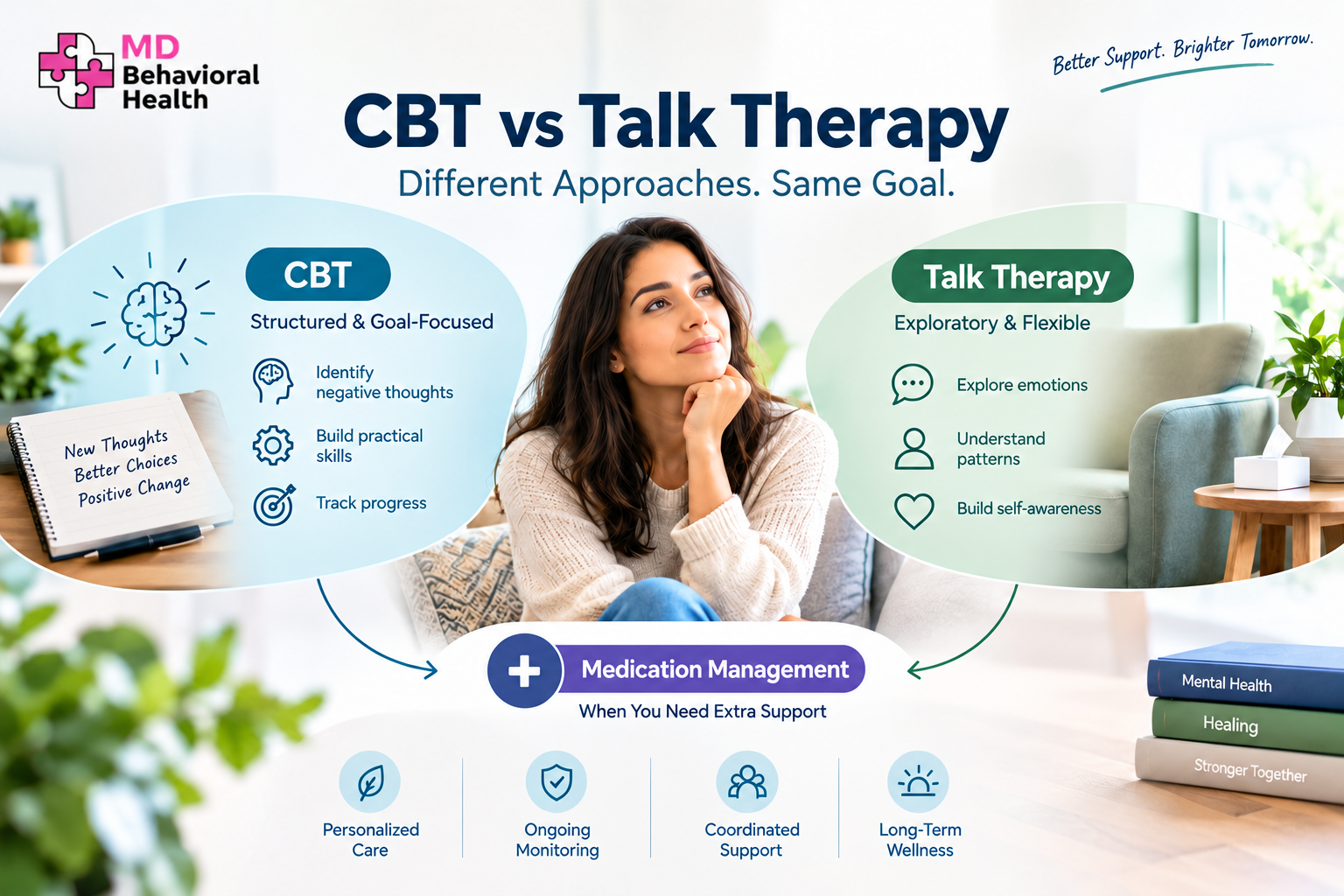
Talk therapy or psychotherapy is a wide term used generally. It refers to various methods wherein a psychotherapist and client, through free-flowing verbal interaction, delve into their thoughts, emotions, relationships, and past experiences. Compared with traditional therapy sessions, sessions of CBT are highly structured. Sessions may wander into childhood memories, current stressors, or relationship patterns, depending on what the client brings that day. The main point of the session, however, is usually to develop an understanding of the client’s inner self and the underlying reasons behind their reactions.
Individuals who wish to have their emotions, grieving processes, or long-standing habits without being confined to a strict method are suitable candidates for such a type of psychotherapy. It can be quite open-ended, and one may attend it for months, even years depending. The speed of progress is largely determined by the client.
What Is CBT?
Cognitive Behavioral Therapy (CBT) is a specific, structured form of psychotherapy. Based on one major belief: that how a person thinks, feels, and behaves are all related, and that the person can learn and change the way he thinks and behaves by first identifying negative thought patterns, challenging them through reality testing, and trying a new approach which is often assigned as homework, the therapist gradually leads the patient to a new way of thinking and behaving.
CBT is usually short-term and goal-focused, commonly lasting between 12 and 20 sessions. It has been found in numerous studies that it is highly effective with anxiety, depression, panic disorder, and insomnia. As it is measurable and tangible, many of those who take advantage of it are grateful for the fact that they are able to observe and feel their progress within a certain period instead of having to go through something indefinite.
Key Differences Between CBT and Talk Therapy
- Structure: CBT follows a defined curriculum with specific techniques and homework. Talk therapy is more flexible and conversational.
- Timeline: CBT usually is only a short-term process (i.e. weeks to months). In contrast, with talk therapy, sessions may continue for a long time, even several years.
- Focus: CBT is oriented towards identifying and solving problems in the present. The talk therapy process is often focused on discussing the root cause of problems in the past and examining the emotional aspects of those issues.
- Measurability: CBT progress is often tracked with specific goals and symptom scales. Talk therapy progress is more subjective and insight-driven.
- Best fit: CBT suits people who want practical tools for a specific problem. Talk therapy suits people who want deeper self-exploration over time.
Neither approach is universally “better.” Whether one therapy or the other is the better option will be determined by the purpose of doing it, the condition for which it is being used, and what kind of person you actually are. Many people also benefit from combining approaches, or from adding Medication Management Services when symptoms are more moderate to severe.
Why Some People Need More Than Therapy Alone
Therapy, whether CBT or traditional talk therapy, is a powerful tool. However, when it comes to the management of such disorders as moderate to severe depression, anxiety, bipolar disorder, or even ADHD, therapy alone may not be able to completely cope with the underlying biological issues. This is where Mental Health Medication Management becomes an important complementary piece of care.
Medication Management involves a licensed prescriber e.g., psychiatrist or psychiatric nurse practitioner who checks your symptoms, prescribes the medication, and keeps track of how you respond in the long run. There is not a single prescription done. There are regular appointments to revise prescriptions if needed, look out for side effects, and, most importantly, confirm that the medication is actually helping you function better in daily life.
Combining CBT or talk therapy with proper Medication Management Services often produces better outcomes than either approach alone, particularly for people whose symptoms are interfering with work, relationships, or daily functioning. A therapist can help you build coping skills, while a prescriber manages the biological side of treatment, and the two providers ideally communicate to keep your care coordinated.
Finding the Right Behavior Health Clinic
If you’re considering cognitive behavioral therapy, talk therapy or a blend of the two that also includes medication, seeking out a behavior health clinic that offers both services under one roof can make your life much easier. Instead of juggling separate providers who may not communicate with each other, an integrated clinic allows your therapist and prescriber to coordinate your care directly.
At Maryland Behavioral Health, this integrated model is central to how care is delivered. Maryland Behavioral Health offers both talk therapy and CBT alongside Medication Management Services, so clients are not forced to choose one path in isolation. The team at Maryland Behavioral Health works to match each person with the therapeutic approach best suited to their situation, and adds psychiatric support when it would meaningfully improve outcomes.
Whether you are dealing with anxiety that CBT could help reframe, or grief that benefits from open-ended talk therapy, or symptoms that need pharmacological support, a coordinated behavior health clinic model reduces the friction of managing multiple, disconnected providers. Maryland Behavioral Health’s approach reflects a broader shift in mental health care toward treating the whole person rather than isolated symptoms.
Making the Decision
Ask yourself a few questions before choosing a path:
- Do I want short-term, structured sessions, or long-term exploratory conversations?
- Are my symptoms mild, or are they significantly disrupting daily life?
- Have I tried therapy successfully before, resulting in the changes I wanted?
- Would I benefit from a provider who can offer both psychotherapy and psychiatric medications?
If your symptoms are moderate to severe, or if therapy alone has not been enough, it is worth discussing Medication Management Services with a qualified provider. This does not mean therapy has failed. It simply means your treatment plan may need an additional layer of support.
Conclusion
The choice between CBT and talk therapy does not have to be mutually exclusive, and it does not have to be made in isolation. The right provider will help you figure out your issues and will guide you towards the right approach for you. This could include medication management services. Maryland Behavioral Health provides this type of service and helps clients work through all the necessary steps in order to get therapy and psychiatric care.
Frequently Asked Questions
- Is CBT better than talk therapy?
Neither is universally better. CBT suits structured, short-term goals, while talk therapy suits deeper, long-term emotional exploration.
- Can I combine CBT with medication?
Yes. Many people benefit from CBT alongside Mental Health Medication Management for moderate to severe symptoms.
- How long does CBT typically take?
CBT usually lasts 12 to 20 sessions, though this varies based on the individual and the condition being treated.
- Do I need a referral to start Medication Management Services?
No, sometimes you don’t. Many organizations, such as Maryland Behavioral Health, permit clients to book a psychiatric evaluation directly.
- What if I’ve tried therapy before and it didn’t help?
It may be worth reassessing the approach or adding Medication Management Services. A coordinated care team can help identify what’s missing.