Anyone who has searched for PTSD therapy services knows the process can feel overwhelming. Between endless directories, unfamiliar terms, and insurance questions, finding the right kind of support often takes a back seat to simply finding any support. Not all therapy approaches are built the same, and understanding the difference between trauma-informed care and traditional therapy can shape how quickly, and how safely, someone heals. The need for this distinction is growing. As per the Single Care report, an estimated 9 million Americans live with PTSD, and about 37% of those individuals experience severe symptoms which is evident from the figure given above that there is much scope for why a specialist approach is so important as against a one-size-fits-all of Counseling.
Traditional Therapy: A Broad but General Approach
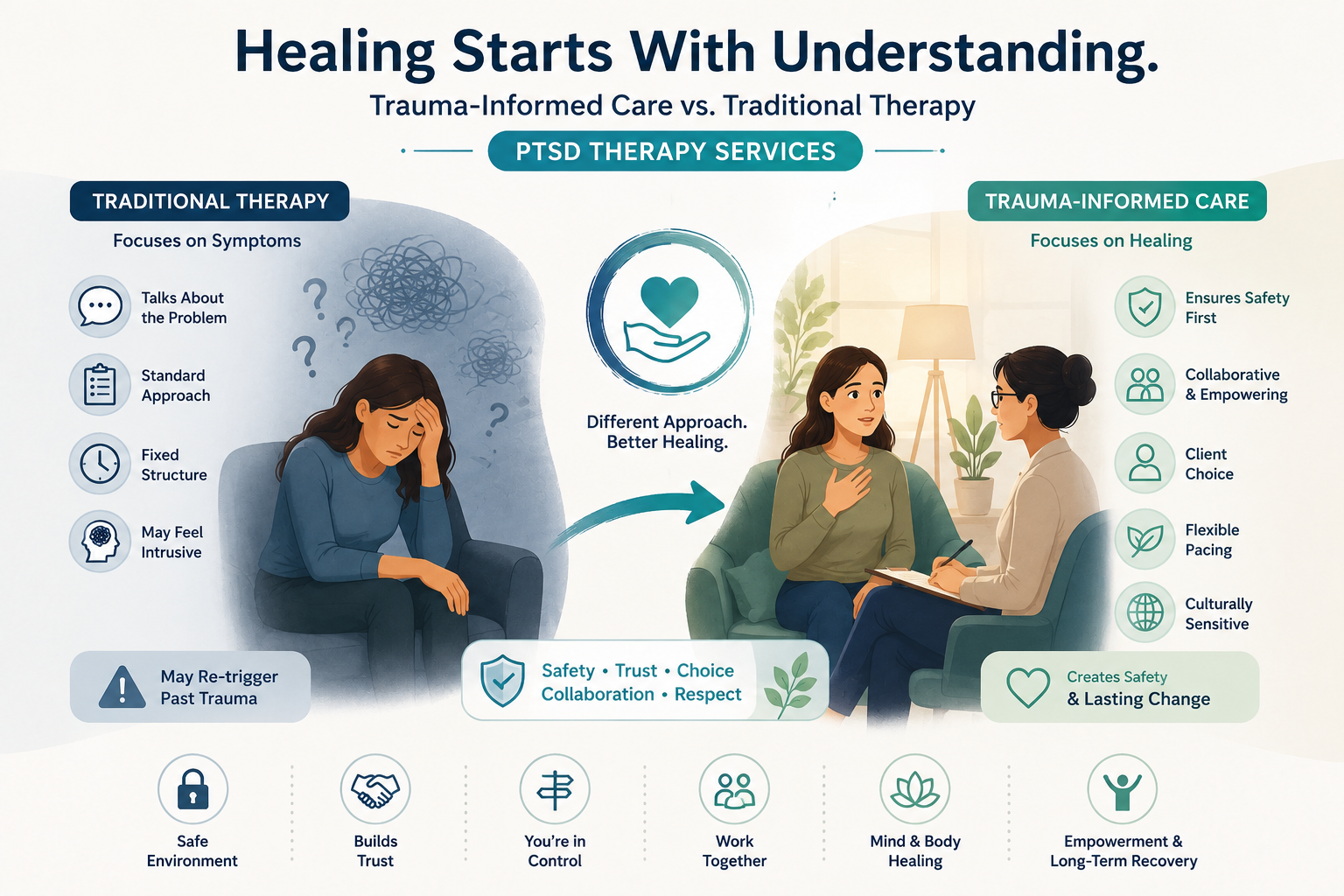
Traditional therapy is typically built around general mental health concerns like anxiety, depression, or relationship struggles. It follows a fairly standard structure: talk about the problem, identify patterns, and work toward coping strategies. This approach is quite successful for many but it wasn’t originally created as a tool for trauma survivors to use. In a traditional setting, a therapist may unintentionally ask questions or use techniques that feel intrusive to someone who has experienced trauma. Without a trauma-specific lens, sessions can sometimes retraumatize a client rather than help them move forward. That’s not a flaw in the therapist’s intentions; it’s simply a gap in specialized training.
Trauma-Informed Care: Built Around Safety First
Trauma-informed care flips the traditional model on its head. Instead of asking “what’s wrong with you,” it asks “what happened to you.” This shift changes how a session unfolds, moving the focus toward safety, trust, and giving the client control over their own healing pace. That is why a trauma counseling service is different, in fact, in a number of key ways from a general practice. Trauma-informed clinicians are trained to recognize signs of dysregulation, avoid re-triggering past trauma, and build sessions around collaboration rather than direction. The client becomes an active participant in recovery, not a passive recipient of advice.
The Core Principles Behind Trauma-Informed Care
Most trauma-informed programs are built on a shared set of principles, regardless of the clinic offering them:
- Safety: In such a way that physical comfort and emotional safety of the person is guaranteed throughout the encounter, from getting out of one’s waiting room into sessions till the end.
- Trustworthiness: Clear communication and consistency help rebuild a client’s sense of trust, which trauma often damages.
- Choice: Clients decide how much to share and when, rather than being pushed through a fixed script.
- Collaboration: Clinicians and clients share the work of creating treatment plans, the latter not being given a list of items to carry out from a top-down model.
- Cultural sensitivity: The providers consider identity, background, and lived experience in the context of trauma-personal relationship shaping.
Providers offering PTSD therapy services from such a holistic view have also a good mix of evidence-based therapeutic interventions like EMDR (Eye Movement Desensitization and Reprocessing) and Cognitive Processing Therapy, plus a variety of somatic therapy techniques that deal with the fact that trauma is stored not only in our minds, but also in our bodies. This is also central to effective post-traumatic stress disorder treatment, since symptoms often show up physically long before they’re named out loud.
Key Differences Between the Two Approaches
- Focus: Traditional therapy targets symptoms; trauma-informed care addresses the root experience behind them.
- Pacing: Trauma-informed sessions move at the client’s comfort level rather than a fixed timeline.
- Environment: Post-traumatic stress disorder treatment centers often redesign their spaces with an aim to decrease the number of possible triggers to a minimum and even the seating arrangements and appointment time might be adjusted.
- Language: Trauma-informed practitioners avoid clinical jargon that can feel dismissive, favoring collaborative communication.
- Empowerment: The client decides what the focus of the treatment is and in which direction it is heading, without a set therapist’s agenda.
How to Choose the Right Trauma-Informed Provider
Not every practice that claims to be “trauma-informed” backs it up with real training or structure. When evaluating a trauma counseling service, it helps to ask a few direct questions: Does the clinician have specific certification in trauma-focused modalities like EMDR or CPT? How does the practice handle a client who becomes overwhelmed mid-session? Is treatment planning collaborative, or dictated entirely by the provider? A genuine trauma-informed practice should be able to answer these clearly and confidently. If a provider struggles to explain their approach beyond general talk therapy, that’s often a sign their PTSD therapy services haven’t been built around trauma-specific training. Teams such as Maryland Behavioral Health are a useful benchmark, since their trauma counseling service is structured around exactly these standards from the first intake call.
Why This Distinction Matters for Long-Term Healing
Choosing the right approach isn’t just a preference; it can determine whether someone continues treatment or drops out early. Clients who feel unsafe or unheard in therapy are more likely to disengage, which is one reason trauma-informed PTSD therapy services report higher retention and better long-term outcomes than generalized talk therapy alone. The philosophy is present at Maryland Behavioral Health in all aspects of the treatment process. The clinicians undergo specific training in trauma-informed care, thereby ensuring that their clients receive treatment that takes their experiences into account. Furthermore, the treatment plans that are used in the center are fully customized in accordance with the history of trauma that a particular client has gone through.
Conclusion
Trauma-informed care isn’t a trend; it’s a necessary evolution in how mental health providers support survivors. The difference between a generic counseling session and a genuinely trauma-informed one can shape whether someone feels safe enough to keep showing up for their own healing. Maryland Behavioral Health works with individuals in search of a caring and scientific way to recovery, providing treatment for post-traumatic stress disorder based on true understanding rather than on standard guidelines. Whether you’re just beginning to seek help or have tried traditional therapy without success, choosing a team such as Maryland Behavioral Health and seeking out specialized PTSD therapy services rather than generic counseling can make all the difference in how, and how well, you heal.
Key Takeaways
- Traditional therapy addresses general mental health concerns, while trauma-informed care is specifically designed around safety, trust, and client-led pacing.
- In trauma-informed care there are five basic concepts: safety, trustworthiness, choice, collaboration, and being culturally sensitive.
- Trauma treatment often utilizes evidence-based approaches such as EMDR and Cognitive Processing Therapy.
- Almost 9 million Americans are living with PTSD right now, while a little more than one in three are living with the most severe symptoms of the condition.
- Asking your healthcare provider if there are any trauma-specific training sessions that they attended can make it easier for you to identify a service dedicated to true, lifelong healing.
Frequently Asked Questions
- What is the main difference between trauma-informed care and traditional therapy?
Trauma-informed care centers on safety and a person’s history, while traditional therapy typically focuses on symptom management without a trauma-specific lens.
- Is trauma-informed care only for people diagnosed with PTSD?
No, it can benefit anyone with a history of difficult or distressing experiences, even without a formal PTSD diagnosis.
- What techniques are commonly used in trauma-informed treatment?
Approaches like EMDR, Cognitive Processing Therapy, and somatic therapy are frequently used to address both psychological and physical effects of trauma.
- How do I know if a provider offers trauma-informed care?
Ask them personally about the nature of the treatment, qualifications, and methods. A practitioner who is truly trained should be able to explain clearly his trauma-specific therapy method.
- Can trauma-informed care be combined with traditional therapy?
In fact, lots of patients are able to obtain a great amount in therapy when they adopt the combination of trauma-informed care and traditional therapy.