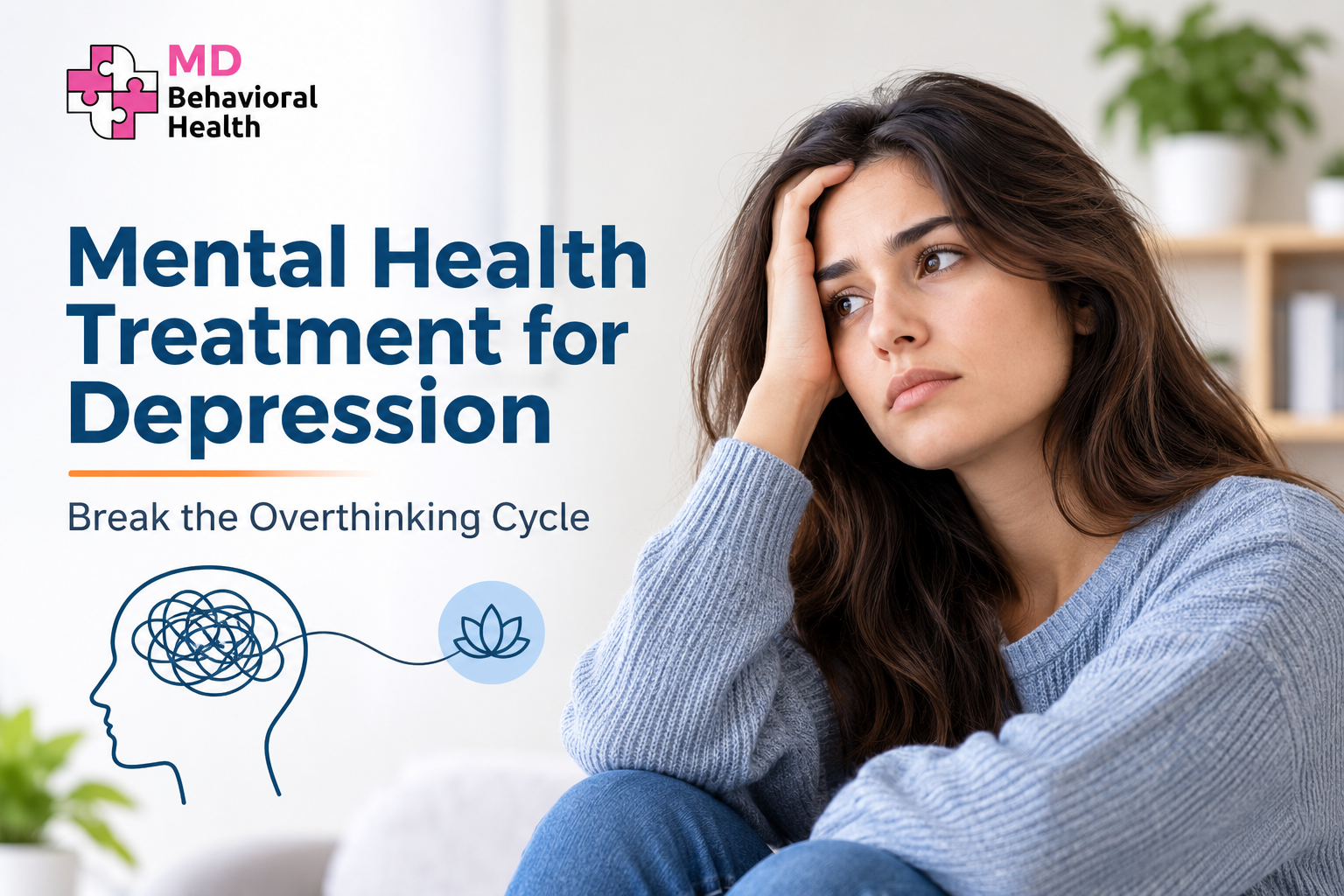
You lie down at night, ready to sleep, and your brain decides it’s the perfect time to replay a conversation from three years ago. Sound familiar? Overthinking feels productive, yet it usually leaves you drained, foggy, and low. For some people, that loop is more than a habit. It can signal a mood shift that responds well to mental health treatment for depression, especially when the exhaustion lingers for weeks. Here’s what’s really happening in your brain, why constant thinking wears you out, and when it makes sense to ask for help.
What Overthinking Actually Is
Overthinking comes in two main flavors. Rumination pulls you backward, chewing on mistakes and regrets. Worry is a kind of imagining that is going to happen in the future that can turn out to be disastrous and you just keep going through all the possible disaster scenarios. Both keep your mind busy without solving anything.
The tricky part is that it feels useful. Your brain treats the loop like problem-solving, so it keeps going.
A simple test separates healthy reflection from overthinking: does the thinking lead anywhere? Reflection ends with an insight or a plan. Overthinking is essentially going around in circles, you keep on turning over the same question, like, “Why did I say that?” or, “what if everything goes wrong?” Perfectionism, high stress, and harsh self-criticism make the loop far more likely.
What Happens Inside Your Brain
Researchers have linked overthinking to the default mode network, a group of brain regions that switches on when you’re not focused on a task. It handles daydreaming, self-reflection, and memory replay. In people prone to rumination, this network tends to stay overactive and chats with the brain’s emotional centers far more than it should.
Here’s how the spiral builds. The amygdala, your internal alarm, flags a thought as a threat. The prefrontal cortex, which normally helps you reason and settle down, gets dragged into the same loop instead of switching it off. Stress hormones like cortisol climb, and your body reacts as if danger were real. Do that for hours and you’ve basically run a marathon while sitting on the couch.
Why Your Mind Feels So Worn Out
Your brain uses about 20 percent of your body’s energy, even at rest. Constant mental chatter burns through that fuel quickly. Add the poor sleep that overthinking almost always brings, and the cycle tightens. A tired brain cannot control emotion that well, therefore a small concern appears as a big one that leads to even more thinking.
Mental exhaustion often shows up as:
- Trouble concentrating or making simple decisions
- Irritability over minor things
- Headaches, muscle tension, or an upset stomach
- Feeling flat, numb, or unmotivated
- Waking up tired no matter how long you slept
When Overthinking Points to Depression
Everyone overthinks now and then. But when the loop hangs around for two weeks or longer and comes with a heavy mood, lost interest in things you enjoy, or sleep changes, it may point to a mood disorder rather than a rough patch. Rumination is one of the most consistent features of depression, and it can stretch out how long an episode lasts.
The encouraging part is that people do reach out. According to the CDC’s National Center for Health Statistics, 19.3% of U.S. adults took medication for their mental health in 2024, and 14.0% received counseling or therapy from a mental health professional. That’s about one in five adults on medication and one in seven seeing a professional. Getting support is far more common than most people assume, and it’s often the step that finally quiets the loop. A proper plan for mental health treatment for depression starts with an honest conversation about what you’ve been feeling.
What Professional Care Looks Like
Mental health treatment for depression usually blends several approaches, and the right mix depends on you.
- Talk therapy: Cognitive behavioral therapy teaches you to catch thought spirals and challenge them. Mood disorder counseling gives you steady space to untangle patterns with someone trained to spot them.
- Medication management: Antidepressants can turn down the background noise in your brain so therapy skills actually stick.
- Lifestyle support: Sleep routines, movement, and time with people you trust all calm an overworked stress system.
- Advanced options: When multiple efforts don’t result in any change, it is possible to treat depression with advanced options that require a medical professional such as esketamine.
At Maryland Behavioral Health, providers offer therapy, medication management, and SPRAVATO® for treatment-resistant depression, with telehealth and in-person visits across Bowie, Silver Spring, and Forestville. Same-week appointments are available, which matters when waiting feels impossible.
Simple Ways to Quiet the Loop Today
Small habits won’t replace professional treatment for depression, but they can take the edge off:
- Name it: Saying “I’m ruminating” creates a little distance from the thought.
- Schedule worry time: Give yourself 15 minutes, then move on.
- Get moving: Even a ten-minute walk lowers tension.
- Write it down: A page of messy notes empties your head faster than replaying it.
- Slow your breathing: Inhale for four counts and exhale for six. Longer exhales help settle your body’s stress response.
- Talk it out: Saying a worry aloud to a trusted friend often shrinks it.
When It’s Time to Reach Out
Consider booking a visit if overthinking and exhaustion last more than two weeks, disrupt work or relationships, or come with hopeless thoughts. Starting early often makes mental health treatment for depression feel more manageable, and clinical depression treatment can begin with a simple evaluation. Pay attention to patterns, too. Pulling away from friends, losing interest in hobbies, changes in appetite, or trouble getting through the workday are all worth mentioning. You don’t need to be sure it’s depression before you ask, because a provider can help sort out what’s going on. At Maryland Behavioral Health, you can talk through what you’re feeling without being rushed or judged. If you ever have thoughts of harming yourself, call or text 988 right away.
Key Takeaways
- If you are thinking too much it turns on your brain’s alarm system which consumes the body’s resources and gives you a feeling of tiredness.
- Poor sleep and mental fatigue feed each other, making worries feel bigger.
- If you feel sad and can’t stop thinking over the same thing for 14 days or more, seeking professional help would be a wise and necessary choice.
- Effective treatment for depression often combines therapy, medication, and healthy daily routines.
- Reaching out is common, and support is available in person and by telehealth.
Conclusion
Overthinking isn’t a personal failing. It’s a brain stuck in an alarm loop, and that loop burns real energy, which is why you can feel exhausted without doing anything physically hard. Understanding the science takes some of the shame out of it and shows why willpower alone rarely breaks the cycle. If the exhaustion keeps returning, mood disorder counseling and other forms of mental health treatment for depression can help you step out of the spiral and feel like yourself again. Maryland Behavioral Health is ready when you are, so book a visit today and take the first step toward a calmer, clearer mind.
Frequently Asked Questions
- Is overthinking a sign of depression?
Not always, but when it lasts two weeks or more alongside low mood, a provider can tell you whether treatment for depression makes sense.
- Why does overthinking make me so tired?
Racing thoughts keep your stress response running and cut into sleep, so your brain never gets a real break.
- Can therapy really reduce overthinking?
Definitely, therapy helps a lot. With techniques of CBT, you get an idea of thinking patterns spiraling out of control and learn to redirect them, while counseling on mood disorders offers you a safe environment to work on your problems.
- What does clinical depression treatment involve?
It typically involves psychotherapy, pharmacological treatment, or a combination thereof along with individualized changes in one’s lifestyle according to their symptoms and history.
- When should I see a professional?
If symptoms last more than two weeks or interfere with daily life, book a visit with Maryland Behavioral Health. In a crisis, call or text 988.


